Showing posts with label sustainability. Show all posts

12.24.2016

Negative Capability

I'm not a big fan of Bob Dylan, but I'm grateful for him being sort of responsible for me learning about Keats' concept of Negative Capability. Apparently, Bob Dylan with his elusive character is a good example of the concept, at least if you are to believe Anthony Decurtis (in The Cambridge Companion to Bob Dylan) and others.

According to Wikipedia, Keats introduced this concept in 1817

"to characterise the capacity of the greatest writers (particularly Shakespeare) to pursue a vision of artistic beauty even when it leads them into intellectual confusion and uncertainty, as opposed to a preference for philosophical certainty over artistic beauty. The term has been used by poets and philosophers to describe the ability of the individual to perceive, think, and operate beyond any presupposition of a predetermined capacity of the human being."

Keats' Kingdom points out that Negative Capability "is a sublime expression of supreme empathy". By using it we can become better at understand different points of views or different cultures so that we might be able to express them.
Known to be a keen reader of the classics, Barack Obama has also been recognised as a person applying Negative Capability by for example by Santi Tafarella and George Packer. When he received the Nobel Peace Prize, Obama said in his speech: “We can acknowledge that oppression will always be with us, and still strive for justice. ... We can understand that there will be war, and still strive for peace.”

I think my former boss Lena Blomberg also can be considered to practice Negative Capability. She always emphasises to consider if reconciliation can be achieved, to find a way to choose both alternatives instead of only one.

I also like the notion of the possibility of something being completely logical and still magical.

Darkness at the break of noon
Shadows even the silver spoon
The handmade blade, the child's balloon
Eclipses both the sun and the moon
To understand you know too soon
There is no sense in trying


Bob Dylan, It's Alright Ma


12.17.2016

History Lesson

We had a discussion, my friend and I, about an article saying that it was not more than fair that history books for schools covered mostly prominent men since they were the ones that had had the most impact on the development of the world. Of course, I didn't agree but at the time I felt that my words fell flat to the ground. I'm not used to having to defend something I feel is so obvious, but I realise that I have to become much better at stating my perspective.

What I believe young people should know about history (and thus make up the text book) is a number of things. History is a matter of perspective. No historic description is neutral. The winners write the history. Most history textbook writers focus on your own country (quite naturally) and the areas or cultures closest to you, often disregarding whole continents and cultures. It's not enough to only learn about Sweden, the Nordic countries, Europe and the US.

We need to learn history because it tells us things we need to know today. If we don't learn from history, we are doomed to repeat it. This is especially true when it comes to the development in Europe and the US today, where we can see fascism grow.

Many different people and situations have had an impact on the development of the world. To believe that only powerful individuals such as presidents, kings, generals and so on are the ones worthy our attention because of their decisions or actions is too narrow. Many individual from all walks of life have had key roles in making history, but their names have been lost. Also, many significant changes have been rather slow and the result of groups acting over time, rather than just one single person doing one thing at a specific moment.
I also think it is important for people to learn about that women many times have been made invisible throughout history. They have made scientific discoveries that their husbands or co-workers have claimed as their own. They have been managers of companies and estates, but been not allowed to own them. Although perfectly able, women have been stopped from entering many professions. There have been societies where women and men have been more equal than most are today. Even though sometimes their role and impact was acknowledged at the time, a deliberate censorship has erased women from the history books.

Just because it is, doesn't mean it should be. Lady Sarah Ashley in the movie Australia

Everybody is responsible for creating the history of tomorrow. The choices we make, the actions we take, the votes we cast. We are all accountable for both creating our society and the story we tell about it.

This is the way I would go about teaching history. And I would never ever say something like the article mentioned above, because I can't see that such a statement would bring me any closer to us having and using history textbooks that embodies those ideas.


12.10.2016

Up Close and Personal

The first time I saw an Anton Corbijn photograph was when I bought the U2 album "All that you can't leave behind" in 2000. I very much liked the photos although at that time I had no idea who the photographer was. I tried to convince my boss at the IT University in Gothenburg that we should use a similar style when shooting pictures for the marketing material, but she went for something more colourful which was probably wise.

Having accompanying the members of U2 for several years, Corbijn has been able to take a number of very relaxed and unexpected photos, some of them on display lately at the Museum of Photography in Stockholm
I suppose that it's quite a different situation when you take pictures of people you've just met and will probably never see again. This was likely the case for Pieter ten Hoopen’s who took pictures of Indian entrepreneurs in the area of sustainable environmental work, who are involved in self-help projects initiated by the organisation Hand in Hand in collaboration with the local population. The exhibition is called Spirit of Change.
When I was working at Chalmers, we started to look into what we called "Impact Photography", that is pictures illustrating change as the result of scientific knowledge. It turned out that the database of photos at the university consisted mostly of pictures of university buildings, students or researchers in white lab coats or standing in front of a bookcase. Unfortunately, I didn't manage to set things in motion before I left.

Change is difficult to describe in one photo, since it's a process. But I think we need to try harder. With the access of rather good cameras in smartphones many more people can take pictures, capturing processes. Getting more up close and personal. Because change is personal, not only for people in India. Or Burma for that matter.

The only baggage you can bring
Is all that you can't leave behind
U2, Walk On

12.03.2016

Sportswashing

It's a bit annoying although perhaps not that surprising that searching for "sportswashing" provides you with lots of links to information about washing machines. The concept seems to have peaked in association with the so-called European Games in 2015. It will probably take a while before it shows up in Google's Ngram Viewer.

I must admit that I hadn't heard of this event before I saw the huge signs still visible in Baku in September 2015. However, since I prefer doing sports instead of watching it this was not so strange.
The Danish initiative Play The Game claims that it's unsure whether Azerbaijan was successful in its sportswashing since it has resulted in at least some relationships gone sour although apparently not with Britain.

"The supposed ideal of the Olympics – and by extension the European Games – is to unite people through sport. With this in mind, a regime that relentlessly proves itself to be an autocratic oppressor of civil liberties is not the sort of partner the International Olympic Committee should be aligning themselves with, let alone actively supporting." Vice Sports

According to The Guardian, Azerbaijan continues its sportswashing, holding the European Grand Prix recently. However, according to Sport for Rights, their luck might be changing since the UN Human Rights Committee has published its findings on the civil and political rights record of Azerbaijan which it examined during its latest session.

I only whish they had used a bit stronger language than that they are "concerned" about the state of affairs...

11.19.2016

Nature Calling

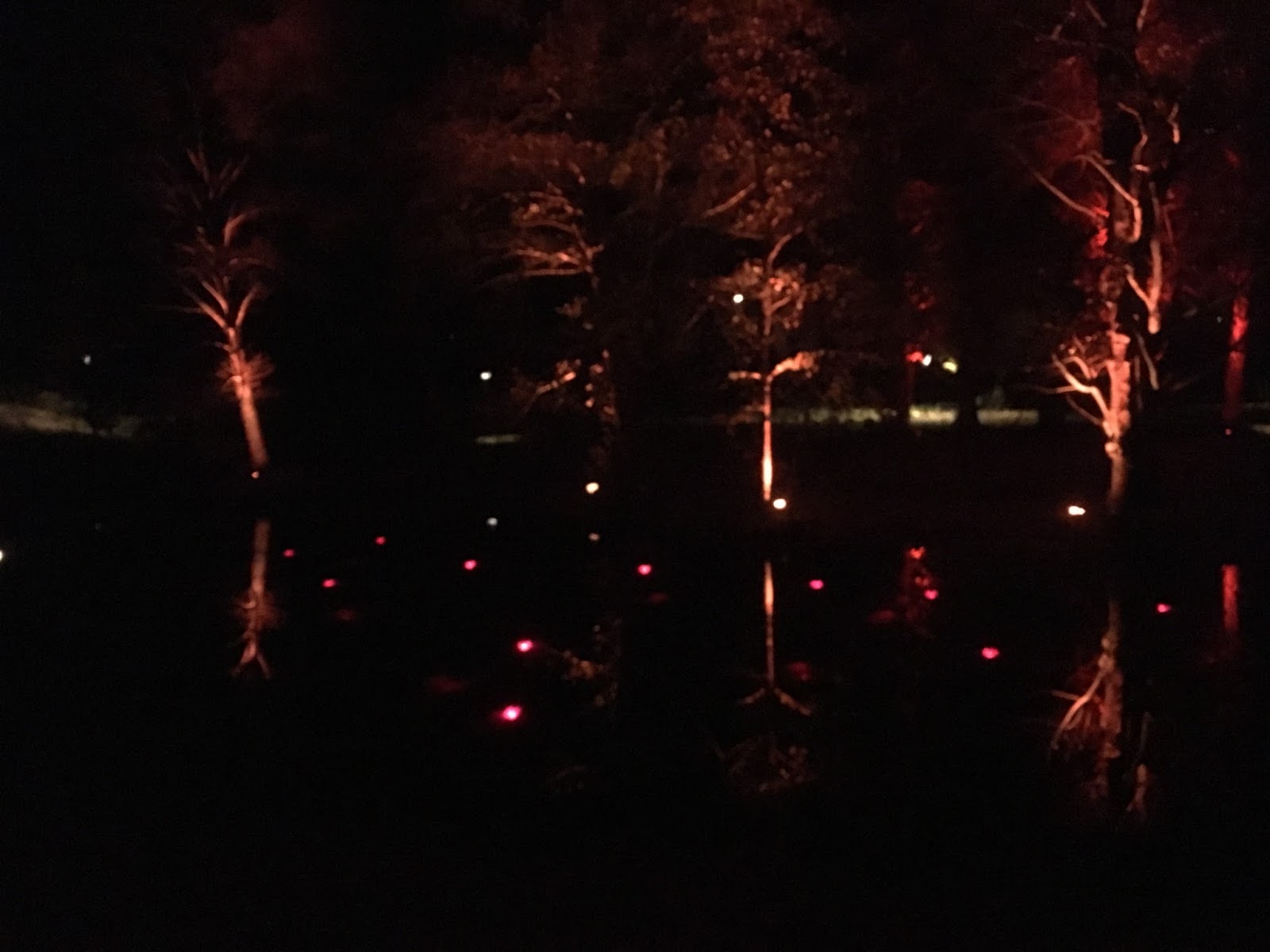
The UN Sustainable Development Goals was the theme for this year's Lights In Alingsås. Every year students work together with professional light designers to create thought-provoking installations. I very much enjoyed the walk in the dark, especially where the lights were reflected in the water.

The first station "A Time to Reflect" was at the church and aimed at making us think about "Peace and Justice. I wonder if they chose the purple colour deliberately.
By pressing "The Red Button" at the river we could change the paradise into an inferno, reminding us of our actions have an immediate impact on the goals regarding Life on Land and Life Below Water. The nicely lit tree in the other direction provided a provoking contrast.
Next stop was at the Abandoned House, referring to goal number 10 regarding reducing inequality within and among countries. Here the lights told us a story of what it's like to be an outsider, only vaguely seen by others.
The installation "Out of Sight, Out of Mind" put the spotlight on the first goal: "No Poverty. Here the refugees were hiding in the bushes, but we could see the trail they left behind in terms of bags and books. We could also experience what it's like to live in a rescue tent.
 The very long installation along the river, illustrating the past, the present and the future of gender equality was both somewhat scary and beautiful. The colour red was frequently used, sometimes as a warm glow but also as a cold warning signal.
"Climate Action" was the goal related to the installation "Nature Calling". With so many people gathering at the spot, it was somewhat difficult to hear what it said. I think it was "Go away!".
The last station was a rather long (in time) but also very beautiful installation called "Life Below Water", providing both insights and hope. The red lamps just below the surface looked rather sinister, like the Nautilus was trapped there.
Since not all of the UN goals were used, this makes room for our own creativity at home. I use a lot of lights in my home, on my balcony and even up the stairs to my apartment. They welcome me and my visitors during the dark part of the year, why I consider them contributing to the goal of ensuring healthy lives and promote well-being for all at all ages.

11.12.2016

Management By Chocolate

When I was working at Innovationsbron, my then colleague and now friend Maria commented that I did something she called "management by chocolate". I had a habit (still do) of bringing chocolate or cookies to all my meetings to share with the participants, since it made the process much smoother. If you use really good dark chocolate, you get satisfied with only a few bits (in theory at least) making you benefit from the antioxidants without getting fat from the sugar.

Being a chocoholic it's good to learn that the chocolate industry seems to work harder and harder on sustainability issues, both social and environmental ones. While browsing the Swedish JournalChocolat I found out that there are several large initiatives going on such as the Cocoa Horizon foundation started by Barry Callebaut, one of the largest cocoa producers in the world. Together with another major chocolate player Mondelèz they have started Cocoa Life, helping the cocoa workers in Africa to improve their situation. They are also a member of the World Cocoa Foundation who support "support cocoa communities, education, field programs and scientific research". This organisation also partner up with other funding agencies such as the Bill & Melissa Gates Foundation in order to create a bigger impact.
Also small producers such as the Swedish Gefle Choklad make their own sustainable products and Scottish Chocolate Tree is famous for their bean-to-bar concept (although I'm a bit hesitant to their Haggis Spice bar...).

In a chocolate shop in Gothenburg I came across a sign saying "Strength is the ability to break off four pieces of chocolate but only eat one". True, true!


10.29.2016

Nudge, Nudge

In an article in 1843, Stanford researcher B.J. Fogg is claimed to be the founding father of "behavioural design", although I doubt that this is correct given that the basic theories have been around and applied for quite some time. However, it's interesting that he, again according to the article, is concerned about what his teachings might lead to although this apparently does not stop him from providing courses and workshops.

Fogg's behaviour model states that three things must happen at once for a specific behaviour to change or happen: The person must want to do it, he/she must be able to, and she/he must be prompted to do it. I really like his "tiny habit" concept, especially the celebration part which is awesome.

Another branch of the behavioural design area is nudging often focusing on making it easy for people to do the "right" thing from a societal perspective such as throwing garbage in bins or taking the stairs instead of the lift. The Behaviour Insight Team is the most prominent example of how this idea can be put to work. They call themselves a social purpose company and are jointly owned by the UK Government, Nesta and the employees.
Volkswagen made use of nudging theories in their much noticed and appreciated The Fun Theory campaign featuring the piano stairs and the deepest bin. The winning concept of "The Speed Camera Lottery" was implemented for a while in Stockholm. Apparently, the average speed which was 32 km/h before the test reduced to 25 km/h during the test, marking a 22% reduction in speed, thereby making the demonstration a grand success. Makes you wonder what it would take to implemented permanently.

One thing I like about the nudging area is that it's based on putting forward hypotheses and then looking at data to explore them. After investigating calls to the police in order to reduce pranks, the BIT team was able to come up with a (perhaps to some extent controversial) suggestion: wait 6 seconds before answering. Apparently, just hearing the phone ring puts pranksters off to a large extent. However, I suppose that it's not that easy to calculate balancing the reduced cost for fewer prankster calls with letting people with serious issues wait longer. There is also the risk of people changing back to former behaviour once the novelty has worn off.

According to their website, the objectives for the Behaviour Insight Team is to make public services more cost-effective and easier for citizens to use, improve outcomes by introducing a more realistic model of human behaviour to policy; and wherever possible, enable people to make ‘better choices for themselves’. What is best for the people is, of course, a matter of opinion.

It's fascinating although to some extent worrying that the same theories and methods can be used for (at least aiming at) societal good and for making profitable although often thoroughly damaging products.

One of Fogg's former students, Nir Eyal, wrote the bestseller "Hooked: How to Build Habit-Forming Products". Another one, Mike Krieger, put his theory into practice and created Instagram. I wonder what governments looking into the teachings of the BIT team will get up to.

Yet another Fogg disciple, Tristan Harris, is a leader in the “Time Well Spent” movement focusing on creating "technology designed to enhance our humanity over additional screen time". I very much recommend reading his article "How Technology Hijacks People’s Minds — from a Magician and Google’s Design Ethicist".
"We need our smartphones, notifications screens and web browsers to be exoskeletons for our minds and interpersonal relationships that put our values, not our impulses, first. People’s time is valuable. And we should protect it with the same rigor as privacy and other digital rights." Tristan Harris


10.22.2016

One for the Team

When I played football (soccer), I played rough when needed although I never received a red card. Not even a yellow one, I think. If a team gets a player dismissed from the football field, it's a real disadvantage and is very much avoided.

In hockey, penalties apparently are part of the game. Although the things the players do to each other in the rink would be considered assault and attempted murder if done outside the arena, they seem to just shrug it off and continue.

When we left the movie theatre after seeing Snowden, I asked my friend if he thought there has been any real change in the way NSA and other similar organisations handle personal information. He was also concerned.
To me it seems like organisations such as the NSA in the US and FRA in Sweden play hockey. Penalties don't really matter, they just carry on as usual. In Sweden, the governmental agency SIUN is the supervisory authority responsible for checking up on FRA and they have remarked ten times on their conduct.

Edward Snowden was given the Swedish Right Livelihood Award in 2014 and many people here thinks he should get sanctuary in Sweden whereas the FBI has requested that he should be arrested and extradited. Some hope that Obama will use his Presidential Pardon, but time is running out.

I definitely think Snowden took one for the team. The team not only being the American people, but the rest of us too. Thank you! Now it's up to us to check on our government and our agencies.

Although Benjamin Franklin did not intend this quote to mean what it has often been used for the last couple of years, apparently being the victim of contextomy, I still believe it deserves some thought:
Those who would give up essential Liberty, to purchase a little temporary Safety, deserve neither Liberty nor Safety.

9.17.2016

Life and Decay

Lots of metaphors and sayings are associated with flowers. People can be blooming. A relationship can be delicate as a flower. In Sweden we talk about city kids as asphalt flowers or dandelion children, indicating that they can grow even if the environment is unfriendly. Orchid kids on the other hand, can become extraordinary but only if taken special care of, according to David Dobbs's piece The Science of Success.

With her photo exhibition Flora Supersum now at Trädgårdsföreningen in Gothenburg, Lena Granefelt makes us aware of other qualities in flowers. She asks us "Can flowers think? Eat, go to war, die? In that case, what do they feel when they prepare to perish?" She notes that books on flowers seldom show what they look like when they are dead or dying, although this is often the state we see them in.
Also, she points out that the flower seeds have both death and life within them. Some seeds need to grow within weeks, whereas others can bring life even after a thousand years.

If persons are like flowers, what kind of life can we bring while we get old and start to wither? We can certainly help the younger generation, leaving them things behind they can thrive on. Does it take a special eye to see the beauty in old? I try to take photos of my garden all year round, although I must admit I take more pictures of flowers that are alive and kicking. Maybe I should take another perspective and look for other characteristics.

“Let us be grateful to people who make us happy, they are the charming gardeners who make our souls blossom.” Marcel Proust

9.10.2016

The Invisible Hand

When I was a kid, I remember watching David McCallum in The Invisible Man. In each session he became invisible at least two times. He's still going strong as an actor, and I now enjoy his quirky act as the Chief Medical Examiner "Ducky" in NCIS.

The Invisible Hand is the metaphor introduced by Adam Smith in 1759 describing his notion that individuals' efforts to pursue their own interest may frequently benefit society more than if their actions were directly intending to benefit society, which has been used as basis for the assumption that trade and market exchange automatically channel self-interest toward socially desirable ends.

Jonathan Schlefer writes in a Harvard Business Review article that there is no invisible hand. He uses a rather nifty analogy to describe the concept:

"The invisible hand sees market economies as passenger planes, which, for all the miseries of air travel, are aerodynamically stable. Buffeted by turbulence, they just settle back into a slightly different flight path. General-equilibrium theory, as it developed in the 1960s and 1970s, suggests that economies are more like fighter jets. Buffeted by a gust, they wouldn’t just settle into a slightly different path but would spin out of control and break asunder if “fly-by-wire” computer guidance systems did not continually redirect them to avert disaster."

Chris Matthews comes to the same conclusion in his article in Fortune. He also can see the reason why US politicians keep referring to it and why the American people continue to believe it.

"For those who are already wealthy, they have little to gain from economic interference. Others are reassured that by simply looking out for themselves they can work towards the greater good. If the invisible hand reflects reality, we have no moral obligation to look beyond our own interests. How convenient."
Matthews continue to point out that Smith also highlighted the benefits of spreading power across many people in a society. Governments can indeed become too powerful, but those who wish to see no government regulation whatsoever have hijacked Smith’s metaphor.

However, David Sloan Wilson argues in an Evonomics article that the invisible hand theory can be made to work if you use evolutionary and complexity theory for example in the form of Multilevel Selection Theory.

"As a basic matter of tradeoffs, traits that maximize the relative fitness of individuals within groups seldom maximize the fitness of groups, relative to other groups in a multi-group population. The general rule is: Adaptation at any level of a multi-tier social hierarchy requires a process of selection at that level and tends to be undermined by selection at lower levels. Or, as another Wilson (Edward O.) and I put it in a 2007 article, “Selfishness beats altruism within groups, altruistic groups beat selfish groups. Everything else is commentary.”"

It's my guess that all the above can be useful when investigating the increasing focus on concepts such as "peer-to-peer economy" and "collaborative economy" as exemplified in the article by Michel Bauwens and Franco Iacomella published in the book "The Wealth of the Commons - A World Beyond Markets and State".

"The peer-to-peer vision relies upon the three major sectors of society – the state, market and civil society – but with different roles and in a revitalized equilibrium. At the core of the new society is civil society, with the commons as its main institution, which uses peer production to generate common value outside of the market logic. These commons consist of both the natural heritage of mankind (oceans, the atmosphere, land, etc.), and commons that are created through collective societal innovation, many of which can be freely shared because of their immaterial nature (shared knowledge, software and design, culture and science). Civil society hosts a wide variety of activities that are naturally and structurally beneficial to the commons – not in an indirect and hypothetical way, as claimed by the “Invisible Hand” metaphor, but in a direct way, by entities that are structurally and constitutionally designed to work for the common good. This sphere includes entities such as trusts, which act as stewards of physical resources of common use (land trusts, natural parks), and for-benefit foundations, which help maintain the infrastructure of cooperation for cultural and digital commons."

For excellent work in Swedish about the collaborative economy I refer to the works of Åsa Minoz and Sara Modig and the excellent report "ABC i kollaborativ ekonomi"!

8.13.2016

The Solitary Reaper

I think many people in Sweden associate the actor Max von Sydow with his appearance in the Bergman movie The Seventh Seal where he plays chess with the Grim Reaper. The scene is filmed at Hovs Hallar, a place I've visited several times.
From Skåne July 2015
After having participated in a course focusing on how to manage and care for a scythe, I can now see from all the pictures of the Grim Reaper that he's not especially apt at using his tool. For example, he's not carrying it in the right, safe way and it's seldom made to fit his height from an ergonomically point of view and often the handles are completely missing.

Apparently, The Grim Reaper is a case of conceptual blending when it comes to metaphors. According to Kovecses, two metaphors are assumed and blended: people are plants and events are actions. This might also explain why there are so many inconsistencies between the mythical creature and an actual harvesting reaper.
Our teacher, Lie-Mats, explained that using a scythe is becoming more and more popular in landscaping. A study showed that over time it's more time-efficient to use a scythe instead of a trimmer since the grass doesn't grow back so quickly. In addition, it doesn't need fuel and it's quite. The last aspect is especially important in environments where people come for an experience, such as Gunnebo Castle where the course took place.

William Wordsworth wrote the poem "The Solitary Reaper" although I don't think he had much first-hand experience of that kind of activity. It's hard work (especially when you don't get the scythe "to dance") but it's also very meditative in character and you get satisfaction in the quick results.

However, in terms of metaphors involving death and agriculture, I prefer this poem by Bo Setterlind:

"Det gick en gammal odalman
och sjöng på åkerjorden.
Han bar en frökorg i sin hand
och strödde mellan orden
för livets början och livets slut
sin nya fröskörd ut.

Han gick från soluppgång till soluppgång.
Det var den sista dagens morgon.
Jag stod som harens unge, när han kom.
Hur ångestfull jag var inför hans vackra sång!
Då tog han mig och satte mig i korgen
och när jag somnat, började han gå.

Döden tänkte jag mig så."

7.16.2016

Sheep View

I was not surprised to learn about the Sheep View initiative. A group of isolated and sparsely populated islands does not come near the top of the list for the Google Street View project, why it's no wonder the Faroe Islander Durita Dahl Andreassen took to a natural resource: sheep.

The Sheep View 360 lets you see parts of the Faroe Islands even few visitors have seen close up. Sheep here graze on the steep hillsides and jump on the cliffs like chamois. I've been to one of the places mapped so far, Tjørnuvik, and I know how tricky it is to walk there and how stunning the views are.

From Faroe Islands 2016
The #wewantgooglestreetview campaign makes the point that Google has taken Street View cameras all over Europe but never to the Faroe Islands. The initiative has gone viral and been picked up by global media such as The Guardian, Washington Post, Wired UK, The Verge, Gizmag, SvD, and so on. A nice additional PR after the Faroe Islands became the National Geographic Readers' Best Trip Choice in 2015.

From Faroe Islands 2016
The project should not be confused with the GoogleSheepView initiative by Ding and Mike, who tries to spot as many sheep as possible by using Google Street View. I think they would really like to have footage from the Faroe Islands, since they have more sheep than people. Ding and Mike have picked up the story too.

Most of the sheep wondering around the islands are ewes and lambs while the rams are kept in pens until they are needed once a year to do their job. When we visited the small village of Gjógv the farmer gathered the sheep to put on markings on the lambs. Many mothers and children got separated in the process, why the baaing kept echoing through the valley all night long. Gathering the sheep must be hard work though, since the special Faroe breed have very little flocking instinct.

When we wandered about the old Tinganes in Tórshavn, our guide Per pointed out a special shed (hjallur), traditionally used for fermenting sheep meat by letting it hang and dry in the salty wind (skerpikjøt). It turns out that the imported sheep meat from New Zealand doesn't work in this process, why this kind of local dish is very rare and expensive. I'm sure that a lot of sheep talk takes place at Tinganes since this is where the government is located.

What to buy at the Faroe Island if not a sweater. I looked into the famous Gudrun&Gudrun shop (the Sara Lund character in the TV series "The Killing" wore one of their designs) but in the end I bought a felt pullover that I later personalised by adding real fleece and sequins to.

I think that the Faroe Islands is a good place for sheep. Lots of fresh grass all year round, you can go where ever you want, few people and cars, no predators, clean air and water, and not so cold in the winter. However, if you are requested to carry solar panels and a web camera all the time...
From Faroe Islands 2016

6.18.2016

Tree of Life

It's no wonder trees have a prominent place in human myths, especially the tree of life. In the Norse mythology, the tree is called Yggdrasil, and is an enormous ash with big roots drinking water from three wells.
From Amsterdam 2016
In 1872, Charles Darwin used the expression Tree of Life as a metaphor for the phylogenetic tree of common descent in the evolutionary sense. Since then, the tree has been drawn in various ways and is still being revised, now based on genetics. The modern tree does not speak of kingdoms but of supergroups who's names you've never heard of: Opisthokonts, Excavates, Amoebozoa, SAR (Stramenopiles, Alveolates and Rhizaria), and Archaeplastids. Guess which one you belong to!

There are several open source initiative targeting species taxonomy issues. For example, The Tree of Life Web Project is a collaborative effort of biologists and nature enthusiasts from around the world who provide information about biodiversity, the characteristics of different groups of organisms, and their evolutionary history.
From Mölnlycke Winter 2016
The Open Tree of Life is funded by the National Science Foundation. It aims to construct a comprehensive, dynamic and digitally-available tree of life by synthesizing published phylogenetic trees along with taxonomic data.

David Attenborough has partnered with BBC and the Wellcome Trust in an interactive version of the Tree of Life. Here you can find a video with him talking about Charles Darwin and the tree of life.
From Brännö 2016
In 2015, National Geographic put out a Tree of Life assignment in their Your Shot department. The task was "to photograph what the Tree of Life means to you, to your community, to your culture, to your world". The instructions were as follows:
  • "Become silent in order to listen. 
  • Slow down. 
  • Visit the same tree on different days, in different light, among various activities, and during different hours.
  • Get close, climb, sit below or on top, and move far away. 
  • Let your perspective change by moving yourself and not the zoom of your lens.
Remember: It's inevitable that something that has been around as long as trees will teach us. This assignment is about looking, becoming silent, listening, learning, and teaching. That which reflects us also reflects our world. Let your trees be a mirror for your world."

For me and my Mum, ashes are weeds and we kill them off as much as we can in our little wood at Ekkullen. However, big ones like the one at the cemetery nearby are beautiful. Their leafs are always late and they are the first to go in the fall. Makes you want to join the Dendrologists.
From Photo Competition 2015

6.11.2016

The Meat Grinder

Long time ago (or at least before WWII) Amsterdam was often referred to as the ‘Jerusalem of the North.’ Some people call it the ‘Venice of the North’. I call it the Meat Grinder. This is what my late Father used to call the traffic model where you put cars, busses, trams, bikes and people on foot at the same level.
From Amsterdam 2016
For a tourist, the traffic situation in Amsterdam is lethal, or at least if feels like it. Bikes everywhere and stopping for nothing. Not people, not cars, not red lights. They don't use helmets. They put small children in boxes without belts on the bike. I even saw a man with a very small baby in a sling on his chest biking.

It comes as a complete surprise to me to learn that approximately 70% of primary schools offer a practical cycling examination when the pupilts are 11-12 years old. Traffic education lessons continue after the pupils transfer into secondary education. Either this is a completely new regulation, or massive amnesia sets in during puberty.

It's easy to believe that bikes have always dominated Amsterdam. Although it was very popular at the beginning of the 20th century, cars became more and more popular and the situation for bikes became very unsafe. The movement "Stop de Kindermoord" grew stronger and together with the oil crisis in the beginning of the 1970s, the local government started to plan more for bikes.
From Amsterdam 2016
Apparently, the number of people using bikes has more than doubled between 1990 and 2014. Currently, 60% of all journeys in Amsterdam historical city centre are by bike. 75% of Amsterdammers own a bike. Many even have two or more bikes: a city bicycle and/or a bike for recreation or a racer. Amsterdam is home to an estimated 880,000 bikes. Right now, the number of traffic incidents are going down but let's just see what the combination of electrical bikes and smartphone does to that statistics.

However, there are other reasons compare Amsterdam to a meat grinder, tearing flesh to pieces. One is the attitude to drugs, another the stance towards prostitution.

I've been to Amsterdam five times and find it wonderful. I love walking along the canals and over the bridges, watching the beautiful houses, shopping at the street markets, basking in the sun in the parks, peering into the art galleries and antiques shops, and gaping at the wonders in the museums. It's strange how you can both love and loathe something at the same time. Or someone for that matter.

6.04.2016

Cat People

When I was in London 2013, I visited the David Bowie exhibition at the Victoria&Albert Museum. It was truly fascinating even for a person like me who is only a small Bowie fan. Seeing all the clothes, stuff and images brought back memories from the film "Cat People". I saw it together with my older sister and her friends, and I remember that I felt a bit uneasy since I hadn't that much experience of erotic thrillers. I liked the theme song though, Putting out Fire by David Bowie.
From Caucasus 2015
I'm so very fortunate in having many cuddly cats nearby but not in my apartment. I love cats, but I'm allergic to them so I can't have them around me all the time. That's why it's purrfect to have friends like the big and bold grey Pelle, the friendly Ragdoll Orion and the playful Tortoiseshell Elsa to pet now and then.

There are quite a few sayings involving cats:
  • Let the cat out of the bag
  • What the cat dragged in
  • Playing cat and mouse
  • Many ways to skin a cat
  • Raining cats and dogs
  • Cat got your tongue?
  • Way the cat jumps
  • Cat on a hot roof
When I met researcher Elin Hirsch she told me that research involving cats is not that common, since cats are not considered especially valuable or esteemed animals (at least in the world of research). That was some years ago, and I think the status has somewhat changed since then. For example, the Swedish University of Agricultural Sciences has a special Facebook page on Cat Research. Currently they are working on a project together with Lund University called Melody in Human-Cat Communication (MEOWSIC) and I do love their logo!
The project is aiming at understanding how cats and humans use melody and other prosodic features when they communicate with each other. They have compiled a list of various cat sounds, with video examples. National Geographic has also made a short video summarising the project. I wonder if the research on cat robots used in the care of people suffering from dementia is taking this into consideration.

Cuddling real cats can pose a danger, since they spread the parasite Toxoplasma gondii. If you get it, you can become more outgoing, risk taking, impulsive and irresponsive (no, I don't think I have it). Strangely enough, this is sometimes called the Crazy Cat Lady Syndrome

5.28.2016

Grass, Bugs, and Apple

The Drone Papers put together by journalists from The Interception are indeed a terrible read in its own right, demonstrating how much resources the US has used in order to find and kill suspected terrorists which also has led to the death of a vast number of innocent civilians.

"The White House and Pentagon boast that the targeting killing program is precise and that civilian deaths are minimal. However, documents detailing a special operations campaign in northeastern Afghanistan, Operation Haymaker, show that between January 2012 and February 2013, U.S. special operations airstrikes killed more than 200 people. Of those, only 35 were the intended targets. During one five-month period of the operation, according to the documents, nearly 90 percent of the people killed in airstrikes were not the intended targets. In Yemen and Somalia, where the U.S. has far more limited intelligence capabilities to confirm the people killed are the intended targets, the equivalent ratios may well be much worse." From The Huffington Post

However, you get another kind if insight reading the story written by one of the people on the death list, Malik Jalal:

"I am in the strange position of knowing that I am on the ‘Kill List’. I know this because I have been told, and I know because I have been targeted for death over and over again. Four times missiles have been fired at me. I am extraordinarily fortunate to be alive.

I don’t want to end up a “Bugsplat” – the ugly word that is used for what remains of a human being after being blown up by a Hellfire missile fired from a Predator drone. More importantly, I don’t want my family to become victims, or even to live with the droning engines overhead, knowing that at any moment they could be vaporized."


The Drone Papers form the basis of the recently published book The Assassination Complex by Jeremy Scahill and The Staff of The Intercept. The foreword is written by Edward Snowden.

"We are witnessing a compression of the working period in which bad policy shelters in the shadows, the time frame in which unconstitutional activities can continue before they are exposed by acts of conscience. And this temporal compression has a significance beyond the immediate headlines; it permits the people of this country to learn about critical government actions, not as part of the historical record but in a way that allows direct action through voting — in other words, in a way that empowers an informed citizenry to defend the democracy that “state secrets” are nominally intended to support. When I see individuals who are able to bring information forward, it gives me hope that we won’t always be required to curtail the illegal activities of our government as if it were a constant task, to uproot official lawbreaking as routinely as we mow the grass. (Interestingly enough, that is how some have begun to describe remote killing operations, as “cutting the grass.”)"

From Sundsby Säteri 2016
There have been several attempts to publish apps tracking the number of deaths caused by US drone strikes such as Metadata+ and Ephemeral+. However, they have been removed by Apple as noticed by The Guardian. This made Mike Elgan at Computerworld wonder if Apple and Facebook are bad for democracy:

"This trend transfers the job of gatekeeper of what political information reaches the public from publications, editors or news directors to the likes of Apple and Facebook -- the companies that choose, in Apple's case, which apps are allowed and which are banned or, in Facebook's case, which news stories or sources are favored by its secret algorithms.

What that means -- and there's no gentle way to put this, so I'm just going to say it -- is that the people in charge of what voters and citizens know are people motivated by selling tiny computers with "selfie cameras" or ads for tiny computers with "selfie cameras" (Samsung is currently the biggest advertiser on Facebook)."


With the US presidential election coming up, it is interesting to see that the drone programme is not a major theme for the debates between Clinton and Trump. Maybe that's because they both agree on lawn mowing or because it's been filtered out by Apple and Facebook.

5.21.2016

Plant Communication

It took a while for the research area "plant communication" to be accepted. In the beginning, researchers in this field were frowned upon and ridiculed, now there are whole book series about the topic. According to an article in Wired, "the debate is no longer whether plants can sense one another’s biochemical messages — they can — but about why and how they do it." As picked up by the BBC, many studies now indicate that the "wood wide web", beautifully illustrated in the Avatar movie, is real and that fungi play a big part.

Part of the controversy is probably the use of words. Are plants intelligent? Do they have emotions? Can they think and learn? Do they have memory, will and consciousness? Can they feel pain?
“Plant neurobiology” is obviously a metaphor—plants don’t possess the type of excitable, communicative cells we call neurons. Yet the introduction of the term has raised a series of questions and inspired a set of experiments that promise to deepen our understanding not only of plants but potentially also of brains. If there are other ways of processing information, other kinds of cells and cell networks that can somehow give rise to intelligent behavior, then we may be more inclined to ask, with Mancuso, “What’s so special about neurons?” From The Intelligent Plant, by The New Yorker
Knowing that plants can somehow interact is one thing but how can this knowledge be utilised? Researchers at Chalmers are looking into how to save energy in green houses by checking how much and what kind of light the plants want. Other researchers have managed to build electrical networks inside plants which in the future might lead to new sources of energy.


Of course, we can also use ICT in connection with plants in other ways. For those who would like a smart garden, there are several appliances around telling you when to provide more water, sunlight and fertiliser. Sensors used in agriculture can help farmers match the crops to different soils and weather conditions, detect parasites

My favourite example of plant communication is however something completely different. In "Operation Christmas" the Colombian Army installed a giant Christmas tree in the jungle in Farc rebel territory. Movement sensors made the tree light up when people approached it. It was decorated with slogans such as "Demobilise, at Christmas everything is possible" and "If Christmas can come to the jungle, you too can come home". The campaign was designed by the Lowe SSP3 ad agency who's been telling their story on TED and on This American Life, which is where I picked it up.

5.14.2016

In Sickness and in Health

About a year ago I participated in the development of a new routine for introducing new employees at Chalmers University of Technology where I work. The concept was brilliant, namely to take a group of new people on a tour of the campus stopping at certain places and telling exciting stories about the buildings and the people who had worked there as well as what's going on there now.

My workplace is in an old building in the so-called Vasa Area at Vera Sandbergs allé. Many years ago it was a hospital for poor, old and mentally ill people in Gothenburg. When my Mum visited me at my office, she told me about the last time she had been there.

For many years my father was the chairman of the Gothenburg Police Male Voice Choir. Then, as well as now, the choir consisted of both active and retired policemen. Before I was born, my parents became friends with an former policeman and his wife. He was an old-school patrolling policeman, tall and sturdy, and he sang in the choir. When his wife died, my parents took extra care to make sure he was all right and kept visiting him. He carved walking sticks and tobacco pipes out of strangely shaped pieces of wood, a bit scary but also fun to look at for a small child.

Then suddenly, but not totally unexpectedly, he fell ill and was taken to the hospital at Vasa. My parents got notice and my Mum went to see him. When she arrived, the nurses told her that he had passed away the day before. Alone. 

The text I provided for the introductory tour roughly translates to this:

"VeraSandberg was the first woman at Chalmers and indeed in Sweden to get an engineering degree in 1917. When she started her education in 1914, she was the only female among 500 male fellow students. It probably took a whole lot of courage and determination for her to take on such a task. This is why it feels extra good for the Innovation Office to be positioned at this particular street, since the utilisation of research also requires a lot of audacity and resolution in order to be successful. In addition, the most important channel for utilisation is probably education, why it feels great to be at a location that puts the spotlight on a former student.


The Vasa Area used to be a hospital, where the chronically and mentally ill were treated. Its first name was ”Gibraltar Fattigvårds- och Försörjningsanstalt” and the decision to build it was made by the city council in April 26 1883. One of the Areas of Advance at Chalmers is Life Science Engineering, an area with opportunities to improve the quality of life for many of those who suffer from similar illnesses today. As a university we have the opportunity to contribute to create a positive impact on society, to help create a sustainable future. It's nice to be in an environment that reminds you of the value our research and education create and can create in the future."