10.31.2015

Fire, Walk With Me

According to our guide in Azerbaijan, the Nobel brothers converted from Christianity to Zoroastrianism when they established their oil business in Baku. As evidence, he pointed to the facts that they used a picture of the nearby (still in use) sacred Atashgah Fire Temple as their logo for the Branobel company and named their first modern oil tanker "The Zoroaster".
From Caucasus Highlights 2015
I'm not totally convinced about the conversion, and I don't think the brothers asked for permission to use the names why they might not have gotten away with it nowadays when for example the Maasai are fighting for the control of their "brand". Then again, I'm not sure how the present-day practitioners of Zoroastrianism would interpret the situation, given that they believe that the purpose in life is to "be among those who renew the world...to make the world progress towards perfection".
From Caucasus Highlights 2015
The Nobel brothers did indeed belong to the ones who renew the world. They were among the first private persons to install a telephone in Baku, they built the first oil tanker, they helped build the railway between Baku at the Caspian Sea and Batumi at the Black Sea, and they funded the first oil pipeline. They also managed to get out before the Soviets took over in 1920, why it is estimated that around 12% of what become the foundation of Alfred Nobel's prize money came from his investments in this venture.

Apparently Alfred was not very happy with the way he had made all his money and how the world would remember him. Maybe he became a bit influenced by the time he spent in Baku, and started to focus on "Good Thoughts, Good Words, Good Deeds".
From Caucasus Highlights 2015
The Zoroaster, however, is still part of the renewal of the world, since its wreck forms the foundation of the artificial oil town Neft Daşları.

10.24.2015

Keeping Stories Or Promises

During one of the long bus drives in Armenia our Swedish guide told us a wonderful story featuring a caravanserai. It's supposed to be true, although I haven't been able to verify it.

Sophie was the daughter of the German ambassador in the Ottoman Empire. She quickly became a favourite at the royal court, since she learned how to speak Turkish and was very interested in the culture of her new homeland.

Since she didn't go home to Germany during the school holidays, the court tried to find ways to amuse her. They gave her a beautiful horse and taught her how to ride. Once they dressed her up as a boy and organised a small caravan travelling parts of the Silk Road.

One evening, one of the servants was bribed to let thieves into the caravanserai and they took all the horses. Soon after, the other servants woke up and started to search for the horses. The night was very dark and although they searched high and low, the horses could not be found. However, they kept on looking since they knew there was no way they could go back to the Sultan and tell him his precious gift was gone. Suddenly they heard the horses far away in the dark and managed to take them back to the serai.
From Caucasus Highlights 2015
During the trip, the caravan came across a family of storytellers. Sophie listened keenly. One night the storyteller said he was tired and asked her to tell a story. She did it and did it very well indeed. He said she could become a "licensed" storyteller, if she promised to never write the stories down.

She almost kept her promise. When she was in her 80ies, the world had changed. The Ottoman Empire was no more and neither storytellers nor caravans could be found. She was afraid that all the wonderful tales she had been taught would be lost, why she started to write them down. The manuscripts are now in a museum in Istanbul.

10.17.2015

Collective Economy

In both Armenia and Georgia, evidence of the failed economic policies of both the Soviet Union and the new countries are abundant. Empty factories are part of the landscape, built by the Soviets, bought by shady businessmen, stripped of everything that could be sold, and then left to decay in a way that only Jan Jörnmark can appreciate.
In the countryside, large abandoned farmhouses can be found in many areas. They are the results of the kolkhoz policy requiring villages to give up their private land to focus on one kind of farming, often irrespectively of what the land was suited for. However, the transition from the Soviet centrally planned economy to a market economy has not been easy. Not every family was prepared for the sudden responsibility for all the tasks involved in farming, leaving a substantial part of the rural population longing for the old times.

Mistakes were also made regarding the major industries and infrastructures, creating private oligopolies instead of having a healthy mix of a large number of both private and public bodies. Monopolies and oligopolies hold about 60 % of Armenia’s market, according to a new World Bank report "Republic of Armenia: Accumulation, Competition, and Connectivity.

In Georgia, the Law on Competition came into force in September 2014 and is supposed to be enforced by The Competition Agency. Since Georgia is very much pro-EU, the law is strongly influenced by EU legislation and reflects concepts from contemporary EU rules and practices. However, not everybody is convinced they are doing a good job.
From Caucasus Highlights 2015
The idea of villages specialising their production has been taken up in other contexts. Japan's OVOP initiative inspired Thailand to introduce the OTOP movement resulting in, among other things, really lovely scarves now in my home. In EU, the Smart Specialisation strategies are spreading, thankfully designed as a bottom-up process and supported by the S3 platform.

Today, there is again much talk about collective economy, although in a somewhat different shape. Maybe there is something to learn from this movement also for the South Caucasus countries and they probably have insights to share. Inspiration can be found everywhere: In Sweden, the Forum for Social Innovation Sweden recently released an ABC in collaborative economy (in Swedish). If you live in Gothenburg, you can join the new Collaborative Economy Göteborg Association. If you're more into going to France, I recommend the next OuiShare Fest in Paris in May.

One aspect of collective economy is the sharing economy trend. It's really easy to get lost in this area where there is a big difference between companies like Uber and Airbnb, making loads of money, and voluntary associations or initiatives not earning a penny. I recommend reading the report "The Sharing Economy - Embracing Change With Caution".

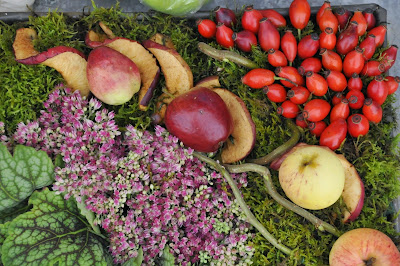
A favourite sharing initiative right now is the Fruktförmedlingen (The Fruit Agency) where you can see where you can get fruit for free in Sweden.
From Höstmarknad sep 2014

10.10.2015

Threat Intelligence

It is important to make an intelligent choice when faced with a severe threat. You probably already know about fight-flight-freeze, but there is another common behaviour among both children and adults: fawn. As I see it, the Stockholm syndrome is a kind of fawn response, where you try to survive by sucking up to your aggressor.

According to Pete Walker, the way you were treated as a child has an impact on to what extent you are able to use all four responses or if you over-rely on one or two. In Armenia, Georgia and Azerbaijan people sometimes talk about Russia/Soviet as there parent nation, their father. Although these countries have much in common when it comes to how they have been treated by both Russian Empire and Soviet, they (or perhaps their presidents) now demonstrate very different coping approaches.

Outside the parlament building in Georgia you find the blue EU flag beside the white Georgian flag with the red crosses. Not only there, but everywhere including TV. Georgia's aggression towards Russia probably cost them both South Ossetia and Abkhazia.
With its oil and gas safely under government control (or perhaps more to the point, the president family's control), Azerbaijan confidently develops the country and its image, the most recent event being the much criticized European Olympic Games 2015. However, being the richest country in the region they are also acutely aware of the hungry eyes from the Russian bear staring at them across the northern border and from the Nagorno-Karabakh region, where they are "helping" the Armenians.

With no natural resources and not much industry, Armenia is very dependent on Russia when it comes to energy and export. Being in conflict with both Turkey (regarding the holy Mount Ararat) and Azerbaijan (regarding the region Nagorno-Karabakh they call Artsakh), takes its toll on the meagre state treasure chest. Although many of the seven million Armenians living outside their home country are chipping in, the leaning on Russia is obvious.
Responses to threat can change, especially after therapy (or a new breed of citizens and technology). Al Jazeera recently reported on demonstrations in Armenia after the decision by Armenia's Public Services Regulatory Commission (PSRC) to raise the prices of electricity by 17%, effective from the beginning of August. The Electric Networks of Armenia is a monopoly owned by Russia.

"While the outcome for Armenia is far from certain, the shock of a resilient challenge to the traditional post-Soviet authoritarian model should worry a number of neighbouring countries. As Russian rule loses stability in the region, the seeds of unrest are bound to spread and grow." Al Jazeera

According to The Huffington Post, the "Electric Yerevan" movement has had a major impact, despite or perhaps because its lack of political leadership:

"A new culture has now been created in Armenia and in the post-Soviet area, a culture of exclusively social movements, "live walls" serving as a deterrent, and this way, the police and the government are afraid to engage in violence against the demonstrators." The Huffington Post

Traces of threats to organisations or countries can be found by surveilling internet traffic and enforcing computer security. Some of these threats are also focusing on ICT infrastructure, becoming cyber attacks. According to Gartner, Threat Intelligence is a growing market. However, as pointed out by Anton Chuvakin, information about a future attack is not enough, you also need a way to handle it, i.e. back to coping strategies.

Perhaps as a threat intelligence service provider you need to take into account your customer's coping strategy, and maybe help him/her/it develop a broader response repertoar making it more agile. Who knows, this broader scope and expansion of language might also help attracting more females to the business.

PS By using social network analysis (first developed by unsuspecting anthropologist) some of the intelligence services in the above mentioned countries have probably pin-pinted you as a potential threat since you are reading this post. Sorry!

10.03.2015

Forget-me-not

Outside the Khan's palace in Baku is a sign commemorating the so called March Days in 1918, when thousands of Azeris where killed by Armenians in the chaotic situation in the wake of WW1 and the Russian Revolution. The word "genocide" is carefully included in the text to describe the horrible event, although perhaps not exactly living up to the definition. A hundred years later, Armenia and Azerbaijan is still at war, with the Nagorno-Karabakh situation unresolved and a million people displaced from their homes.

To the untrained eye, the holes in the wall surely looks like they were made by bullets. However, nowhere is information found about the September Days from the same year, when the Ottoman Islamic Army of the Caucasus advanced and together with the local Azeris killed about the same number of Armenians in Baku.
This year Armenia commemorates The Armenian Genocide Centennial. The forget-me-not has been chosen as a symbol, and can be found everywhere in the country: on shop doors, on taxis, in hotels, out in the countryside and in Jerevan.

"The color of black symbolizes horror and the memories of the Genocide. The yellow color symbolizes the sunlight, which gives hope to live and create. The inner radial light purple symbolizes involvement in the recognition and condemnation of the Armenian Genocide. And the predominant purple lies in the basis of Armenians’ self-consciousness, in vestments worn by the servants of Armenian Apostolic Church."
During the summer of 2015, the Swedish newspaper Svenska Dagbladet held a competition to where you could vote for the most beautiful word in the Swedish language. Words such as "snöflinga" (snowflake), "glänta" (clearing in the wood), "juninatt" (night in june), "gryning" (dawn), and "västanvind" (wind from the West) were suggested, but it was "förgätmigej" (forget-me-not) that won.

The author Björn Ranelid, who were among the people who had suggested this word, motivated his choice this way:

"What joy to be a wish, a desire and a declaration in one single word. However, the imperative does not have an exclamation mark in its tow, but hides a neglected verb in its chalice." (my own, very crude translation)

9.26.2015

Dead Souls

In his book Changing Places, David Lodge introduces the game Humiliation. It's about confessing great books you've never read. Apparently, for AS Byatt, one of her entries was/is Gogol's "Dead Souls, now in a new English translation.

Landowners in Tsarist Russia were taxed on their payroll of serfs (souls), which included those who had died between tax-assessments. At one level, Gogol's book describes how a man, Chichikov, has formed the plan of buying the dead souls of various landowners in order to use his list of fictive slaves to buy real land to "resettle" them and to become a landowner himself. However, the book is much more complex than that, why I recommend Dead Souls Demystified for a more thorough analysis.
From Berlin 2015
According to Tom Reiss, the Jewish oil barons from Baku, who after the Russian revolution escaped to Berlin, talked about their oil wells as "lost souls". They had surely read Gogol's book and perhaps discussed it with Vladimir Nabokov, who also had fled Russia for Berlin.

There is much to say about Russia and oil, and its history is full of dead souls of all kinds, perhaps especially the kind that Chichikov represents according to Byatt:

"Chichikov himself is also of course, a dead soul, a man self-designed to be unremarkable, agreeable and acceptable, a smiling confidence-trickster whose plots, as Nabokov points out, are neither very clever nor very coherent."

Or, using Nobokov's words, he is the manifestation of the untranslatable Russian concept of poshlost.

9.19.2015

Compulsory Vacationer

In the beginning of small workshops I often introduce an exercise aiming at making the participants aware of their own role in the outcome. I'm not sure where I picked it up, but it probably was from Esther Derby and Diana Larsen who combined the ideas behind agile software development with appreciative inquiry to create a new way of doing Lessons Learned sessions called “Agile Retrospectives”.

In the exercise all participants are asked to report anonymously which of the following roles they will take on during the workshop: Explorer, Shopper, Vacationer or Prisoner.

Explorers are eager to discover new ideas and insights, and really wants to contribute. Shoppers will be happy to go home with one or two useful new ideas. Vacationers aren’t especially interested in the workshop, but are glad to be away from the daily grind.  Prisoners feel that they’ve been forced to attend and can actually sabotage the workshop. Should the group consist of only vacationers and prisoners, then the workshop really needs to focus on why that is the case. Thankfully, that has never been the case during my workshops.

However, I wonder if not people take on the same role no matter the topic of the workshop. Although we certainly differ in our interest in various areas, I think our general disposition shines through.

We often get stuck in old habits. When I drive to visit my sister and her family in Jönköping, I pass a a campsite just beside the motorway at Ulricehamn. Apparently people return to this place every year and some caravans stay during winter. The view of the lake is beautiful and the small town is quaint, but the beach is nothing special and the roar from the road must be deafening. I shake my head in wonder and drive on.

I must admit though, that I too have my special places I seem to return to over and over again. One of them is the sculpture park Pilane at the west coast of Sweden (2015, 2014, 2013, 2012, 2011, 2009, 2007). Another is the amazing garden at Läckö Castle (2015, 2012, 2010, 2009, 2008, 2007) designed by Simon Irvine who was there when I visited this year. Nearby Peter Korn's garden is also a must (2015, 2013, 2011, 2007) and he's always so nice to talk to.

I suppose it's the combination of certain recognition and elements of surprise that keeps me going back. Maybe this is a habit I share with other people!?!